We asked ChatGPT 100 questions about Adelaide businesses.
We asked ChatGPT 100 questions about local businesses across Adelaide, the way people ask when they need someone. Then we compared its picks with Google Maps and looked into the websites it read before answering.

On this page
The short version.
- Every one of ChatGPT’s 100 answers was a short list of businesses on a map, each with a rating, review count, phone number and, nearly always, a website.
- Its picks looked a lot like Google Maps. 81% of the business cards it showed were for businesses in Google Maps’ top 10 for the same search, and Google’s top result made ChatGPT’s answer 81% of the time.
- Before answering, ChatGPT searched review sites and “best of” lists. Some of those sites say on their own pages that businesses can pay for a better position.
- Ask the same question twice and the list changed most of the time.
- Three days after our test, OpenAI let businesses claim their listing in ChatGPT. Local businesses outside the US can’t yet.
- The best preparation is a complete Google profile, plenty of real reviews and a website that says what you do.
How we ran the test.
We covered ten kinds of local business: plumbers, electricians, dentists, hairdressers, cafes, mechanics, physios, vets, nail salons and accountants. We asked about each in eight areas across Adelaide: Norwood, Glenelg, Salisbury, Morphett Vale, Prospect, Unley, Mount Barker and Port Adelaide. For each kind we added a “best in Adelaide” question and a problem, like “My car’s making a grinding noise when I brake, where should I take it?” That made 100 questions, written the way people talk and asked in a random order. We asked 19 of them a second time.
We used ChatGPT’s temporary chat, which ignores past chats and settings, on its quick default setting, from Adelaide, on the morning of 7 November 2026. The same morning we searched Google Maps for the same thing in each of the 80 suburb questions, such as “plumber Norwood SA”, and recorded the top 10 results, leaving out ads.
It’s one account, one location and one morning, with questions we wrote, so it’s a snapshot rather than a representative sample. Treat the numbers as a guide. We don’t name any business ChatGPT recommended. The point is how it chooses.
ChatGPT answers with a map of businesses.
All 100 answers showed between three and six businesses on a map, 420 business cards in all. Nearly every card had what a customer needs to decide:
| On the card | Cards that had it |
|---|---|
| Opening hours | 417 of 420 |
| A star rating | 416 of 420 |
| Phone number | 412 of 420 |
| A link to the business’s website | 395 of 420 |
ChatGPT favoured well-rated businesses. Nine in ten of the ratings it showed were 4.5 stars or more, and only six were under 4. A long track record wasn’t required: 73 cards had fewer than 30 reviews.
Its picks look a lot like Google Maps.
For the 80 suburb questions, we compared ChatGPT’s businesses with Google Maps’ top 10 for the same search.
- Of the 328 business cards ChatGPT showed, 267 (81%) were for businesses in Google Maps’ top 10, and 147 (45%) in the top 3.
- Google’s number one result appeared in ChatGPT’s answer in 65 of 80 questions.
- In 77 of 80 questions, at least one of ChatGPT’s businesses was in Google’s top 3.
- Where we could compare them, the star rating on ChatGPT’s card matched the business’s Google profile 91% of the time, and the review count was within three reviews 84% of the time.
OpenAI hasn’t said where most of its business information comes from. Yelp licenses its reviews and listings to OpenAI, but none of the 420 cards in our test was marked as Yelp data. Local search analysts noticed in December 2025 that ChatGPT’s business panels look like Google Business Profile data, and our results point the same way.
Cafes were the exception. ChatGPT marked 32 of its 47 cafe cards as TripAdvisor data. For every other kind of business in our test, TripAdvisor supplied one card in total.
It reads review sites and “best of” lists first.
ChatGPT searched the web before every answer and pulled up 267 different websites across the 100. These came up most:
| Website | Answers it came up in |
|---|---|
| Word of Mouth | 54 of 100 |
| Starworks | 38 of 100 |
| Birdeye | 36 of 100 |
| Allfives | 33 of 100 |
| LocalityBiz | 25 of 100 |
| hipages | 17 of 100 |
| Right For Me | 16 of 100 |
| Yellow Pages | 15 of 100 |
ChatGPT named a website as a source in 39 of the 100 answers. Starworks was named most, in 10. A business’s own website was named in 12.
Search results don’t prove what ChatGPT relied on. But they show where it looks, so we read what those sites say about how they work.
Some of those sites say payment affects position.
Two of the sites that came up most say so on their own pages.
- Starworks is open about how its lists work. Its service for businesses, Starworks HQ, says each list mostly follows public reviews and published facts, and that most businesses on its directories have never paid it. It also says it sets positions by hand, can place a business on any of its lists, “including a business that pays us”, and gives a placed business “no badge, no Featured box, no Sponsored label”. It says it runs more than 100 directories and city guides. Six of the websites in our test are registered to the same business, and together they came up in 50 of the 100 answers.
- Word of Mouth’s help page for businesses says that when results are sorted by highest rating, “businesses on our paid plans are given priority”, because, it says, those businesses make customer service a priority and actively encourage reviews. Its Essentials plan, $490 a year, includes “Priority ranking in search results”.
None of this shows that any business ChatGPT named had paid, or that payment changed its answers. It does mean some of the pages ChatGPT pulls up before answering can be ordered partly by payment, and where a placement carries no label, a reader can’t tell which.
We also found 17 newer “best of” sites with the same design and footer, each saying it has been publishing since October 2026, most of them registered to the same owner. They came up in 59 of the 100 answers. On the pages we could read, they don’t sell placement.
Ask twice, get a different list.
We asked 19 questions twice, minutes apart. The businesses changed in 14 of them. On average the two answers shared about four businesses. One mention, or one missed mention, tells you very little.
What this means for your business.
- Treat your Google Business Profile as your ChatGPT card. Check your name, category, hours, phone number and website. In our test, nine in ten of ChatGPT’s star ratings matched the business’s Google profile.
- Earn reviews steadily. ChatGPT favoured businesses rated 4.5 stars and up, and it didn’t need hundreds of reviews to pick one.
- If you run a cafe or restaurant, look after your TripAdvisor listing as well.
- Be listed accurately on the directories for your trade, with the same name, address and phone number everywhere.
- Make the page your website link opens say what you do and where, and make it easy to call or book.
- When ChatGPT’s Business Hub opens to local businesses in Australia, claim your listing. It won’t move you up, but it keeps your details current and shows how often you come up.
- If someone offers to get you named first in ChatGPT, ask what they’ll change, whether it’s labelled, and what happens when you stop paying.
ChatGPT now shows businesses how often they come up.
On 10 November 2026, three days after our test, OpenAI launched Businesses in ChatGPT, in beta. A business finds its listing in ChatGPT’s Business Hub, proves it’s theirs by phone, email or their website’s domain, then passes an identity check. After that it can update its description, website and logo, and see 28 days of mentions, website clicks and the topics it came up in. For a local business, a mention counts whenever ChatGPT shows it in an answer.
There’s a catch for Adelaide. OpenAI’s setup guide says that, for now, local stores and restaurants can only claim an existing listing in the US. OpenAI says it plans to reach more countries and kinds of business, but hasn’t said when.
OpenAI is also clear about what claiming doesn’t do: “Claiming does not guarantee higher placement or sales.” Its help page adds that advertising doesn’t influence ChatGPT’s own answers.
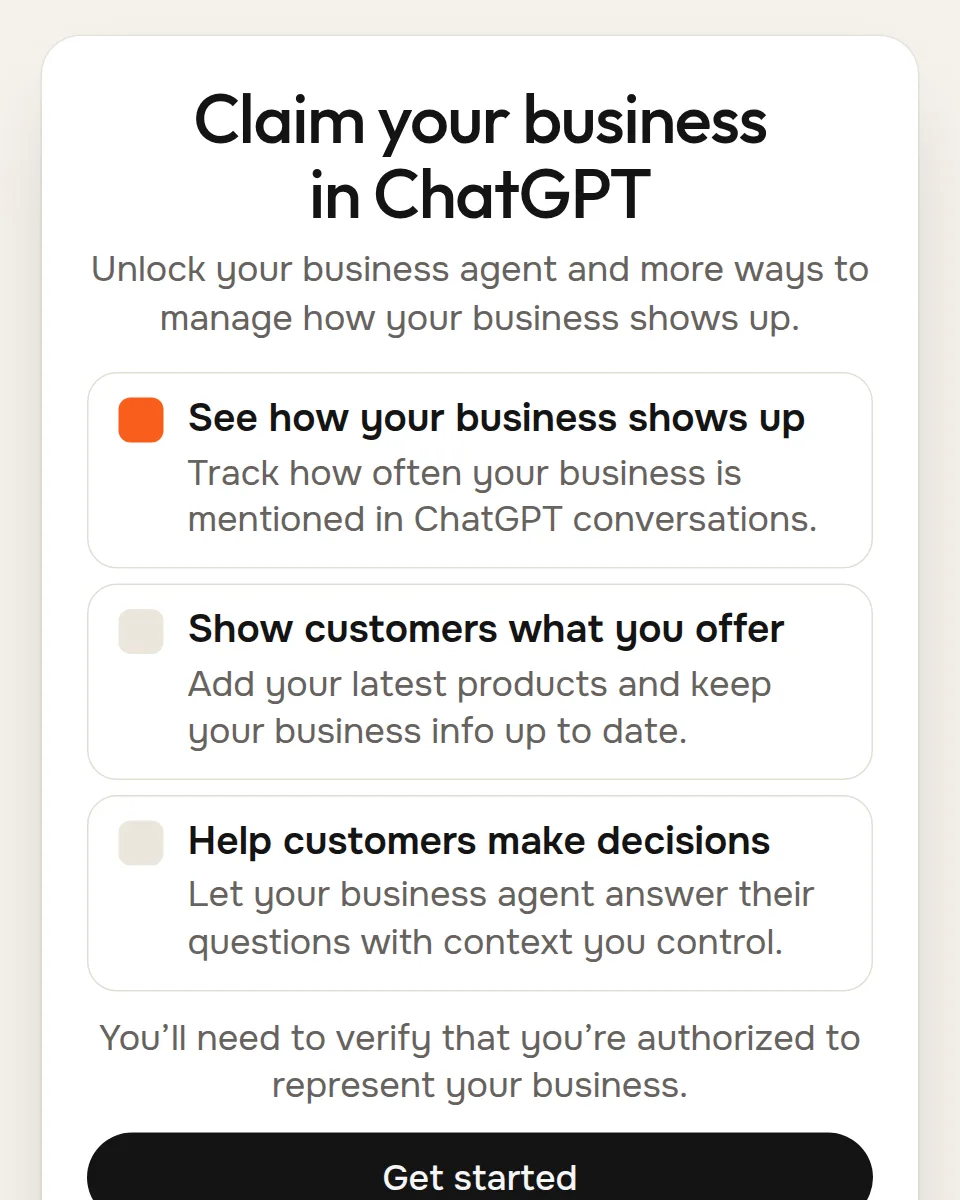
When it reaches Adelaide, it will show the mentions and clicks. It won’t count the people who see your name in ChatGPT and then ring you.
You can already see some of this. When ChatGPT linked to a website in our test, the link carried a
tag, utm_source=chatgpt.com. In Google Analytics 4, go to Reports, then Acquisition, then
Traffic acquisition, and set the table to Session source / medium. Look for chatgpt.com.
A mention only matters if someone calls.
What pays is the call, the form or the booking after someone sees your name, and most of those won’t show up as a click from ChatGPT.
That’s why we count enquiries: Google profile calls, phone taps, forms and booking clicks. We look after Adelaide businesses’ websites, SEO and Google profiles together, and check what ChatGPT, Gemini and Google’s AI Overviews say about them as part of the SEO work. We don’t promise AI mentions, because nobody controls them. We report enquiries, not rankings.
To see how your business shows up on Google and in AI answers today, start with a free visibility audit, or read how we handle SEO in Adelaide and Google Business Profile management.
Questions people ask.
Where does ChatGPT get its local business information?
OpenAI hasn't said where most of it comes from. Businesses can now add details through ChatGPT's Business Hub, and OpenAI says profiles can also include information from other sources, without naming them. Yelp licenses its reviews and listings to OpenAI, but none of the cards in our test was marked as Yelp data. The businesses ChatGPT recommended were mostly the ones near the top of Google Maps for the same search, nine in ten of the ratings we could compare matched the business's Google profile, and for cafes most cards were marked as TripAdvisor data.
How do I get my business recommended by ChatGPT?
Nobody controls ChatGPT's answers, and they change from one asking to the next. What we saw rewards the basics: a complete Google Business Profile, a strong rating from plenty of real reviews, a website that says what you do and where, and accurate listings on the directories for your trade. Once ChatGPT's Business Hub opens to local businesses in Australia, claiming your listing will keep your details current, but OpenAI says claiming doesn't guarantee a higher place.
Should I pay to be on a 'best of' list?
Ask how the list is ranked, whether paid positions are labelled, and what happens when you stop paying. Some lists say on their own pages that paying customers get a better position, so you'll know what you're buying.
How do I see visits from ChatGPT in Google Analytics?
In Google Analytics 4, open Reports, then Acquisition, then Traffic acquisition, and change the table to Session source / medium. Visits from ChatGPT show as chatgpt.com. That counts people who clicked through to your website, not the times you were mentioned.
9 sources
- Is Starworks HQ legit? Straight answers (opens in a new tab), Starworks HQ, updated 2 November 2026, read 7 November 2026
- FAQs for businesses (how results are sorted) (opens in a new tab), Word of Mouth, read 7 November 2026
- Essentials plan (opens in a new tab), Word of Mouth, read 7 November 2026
- ChatGPT local results now feature a knowledge panel (opens in a new tab), Near Media, 19 December 2025
- ChatGPT gains access to Yelp reviews, ratings and photos (opens in a new tab), Search Engine Land, 23 July 2026
- ChatGPT is building an analytics tool to track how often your business is mentioned (opens in a new tab), Juozas Kaziukėnas on LinkedIn, 6 November 2026
- Introducing Businesses in ChatGPT (opens in a new tab), OpenAI, 10 November 2026
- Businesses in ChatGPT: claim your business (opens in a new tab), OpenAI, read 11 November 2026
- Setting up your business on ChatGPT (opens in a new tab), OpenAI Help Center, read 11 November 2026