A web designer quotes you $8,000 and you write it down as the cost of your website. It isn’t. It’s the deposit on a bill that keeps arriving every month after launch. That gap, between the sticker price and the real web design cost in Adelaide, is where most small business owners get caught out. The build is the part you can see. Hosting, security, backups, edits and SEO are the part nobody puts on the quote, and over three years they often add up to more than the build itself.
So this is the honest version. Four real ways to pay for a website in Adelaide in 2026, each with sourced Australian dollar ranges, what they include, and who they suit. Then a fair look at why ‘you get what you pay for’ is really a question about total cost over three or four years, not a slogan. We’ll be straight about DIY, freelancers and agencies, because each one fits a different kind of business.
The short version: A website has two prices: the build and everything after it. DIY builders run about $200 to $1,500 a year, a cheap freelancer about $1,000 to $10,000 upfront, a mid-range agency $8,000 to $25,000 or more, and a premium studio $25,000 to $100,000+ (Strong Digital, Spark Interact, 2025 to 2026). On a one-off build, ongoing hosting, maintenance and SEO are separate invoices, commonly $100 to $500 a month on top. A plan that bundles those ongoing costs into one monthly fee is a different way to carry the same total. None of these is best for everyone. All figures are typical 2025 to 2026 Australian ranges, not fixed prices, and platform pricing (especially Shopify, billed in USD) shifts.
The number a designer quotes you is not the number you pay
Most quotes show one figure: the build. But Australian guides are clear that ongoing upkeep for a small business site runs separately, commonly $100 to $500 a month for maintenance alone (WP Creative, 2026), before you add hosting or SEO. That recurring stack is the part the sticker price quietly leaves off.
The maths catches people out. A build is a one-time number. Hosting, SSL, daily backups, security monitoring, the odd content edit and any SEO are forever numbers. They land month after month, year after year, for as long as the site is live. Add three years of that to the original quote and the ‘cost of the website’ looks very different from the number on the proposal.
Total cost of ownership is the only fair way to compare options. It means the build plus everything you’ll spend keeping the thing alive and working over its life. Once you frame it that way, a cheap build with expensive, fiddly upkeep can cost more than a pricier one that included the upkeep. And a single monthly fee starts to look less like a gimmick and more like a different way to carry the same costs.
One caution before the numbers. Every figure below is a typical Australian range for 2025 to 2026, drawn from published pricing guides, not a precise fact about your project. Quotes vary by scope, complexity and who you ask. Platform subscriptions move too, and Shopify bills in US dollars, so its Australian cost shifts with the exchange rate.
The four ways to pay for a website in Adelaide
There are four honest routes, and Australian pricing guides put them in a clear ladder: DIY builders at the bottom, then cheap freelancers and template shops, then mid-range agencies at roughly $8,000 to $25,000+, then premium studios from about $25,000 to $100,000+ (Strong Digital, 2025 to 2026). Each one fits a different stage of business.
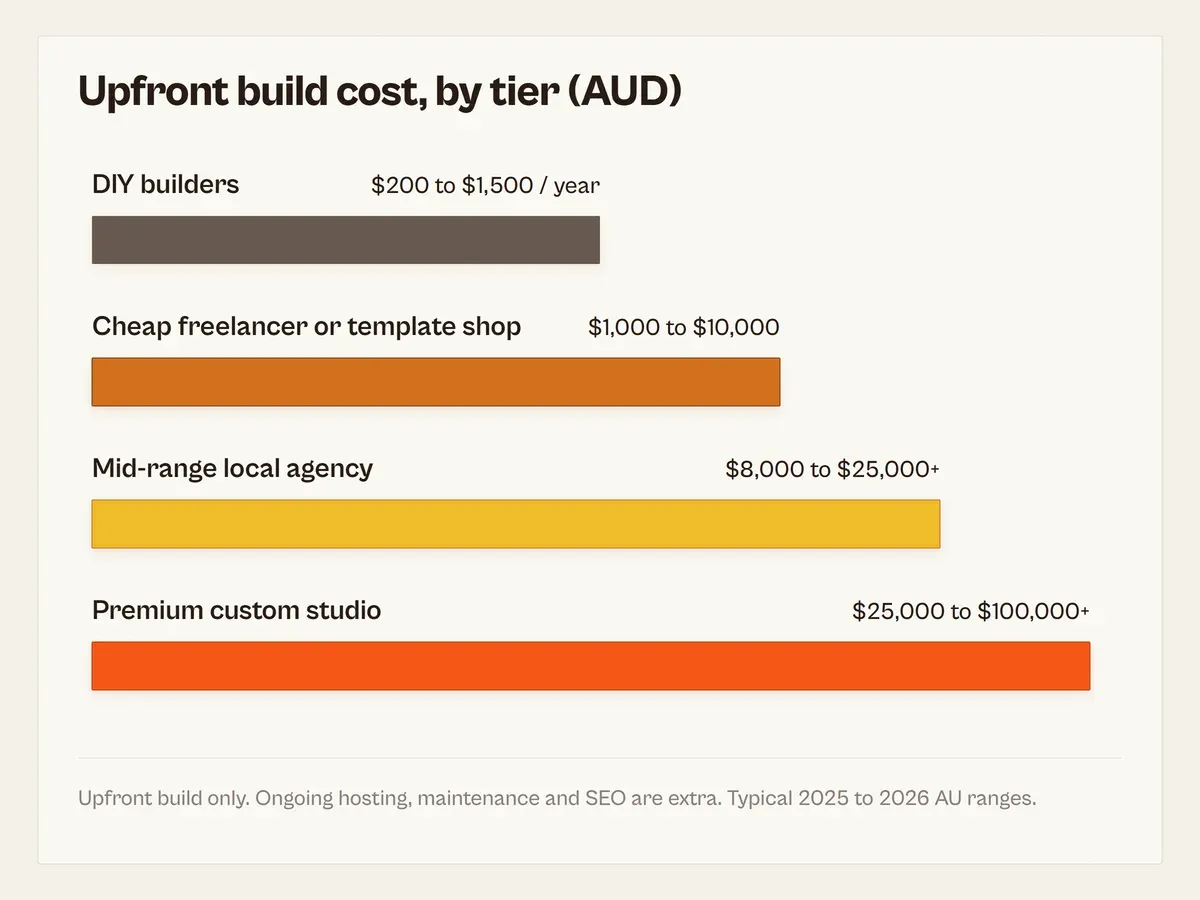
Upfront build cost only. Ongoing hosting, maintenance and SEO sit on top of every tier. Typical 2025 to 2026 Australian ranges.
None of these tiers is good or bad on its own. Each is fit for a purpose, and the trick is matching the tier to where your business sits, not to what looks impressive. A solo operator testing an idea has no business spending $25,000, and a busy clinic with real revenue is poorly served by a $200-a-year template it has to run alone.
One Adelaide-specific note. The published Adelaide studio prices we quote below sit a little under the national agency band, so treat them as illustrative real examples from individual studios, not the city average. Read them as ‘one real price list’, not ‘this is what everyone charges’. Take the four tiers in turn.
| Tier | Typical upfront (AUD) | Ongoing (separate) | Best for |
|---|---|---|---|
| DIY builders (Wix, Squarespace, Shopify) | About $200 to $1,500/year all-in | Subscription is the cost; domain $10 to $50/year | Solo operators and pre-revenue testing |
| Cheap freelancer or template shop | About $1,000 to $10,000 | $100 to $500/month once added up | Tight budgets with someone to manage upkeep |
| Mid-range local agency | About $8,000 to $25,000+ | Retainer $250 to $500/month, plus SEO | Growing businesses that can fund both |
| Premium custom studio | About $25,000 to $100,000+ | $3,000 to $10,000+/month enterprise | Established firms with complex needs |
Sources: Strong Digital (2026), Spark Interact (2025), WP Creative (2026), StudioHawk (2025). Figures are typical Australian ranges, not fixed prices.
DIY website builders (Wix, Squarespace, Shopify)
DIY builders are the cheapest entry point by a distance, running roughly $200 to $1,500 a year all-in (Strong Digital, 2026). Subscriptions sit around $5 to $30 a month for Wix small-business tiers (White Peak Digital, 2025), and roughly $24 to $149 a month for Squarespace billed monthly (about $17 to $109 on annual billing), with hosting and SSL bundled into the price.
What you get is a templated site you build and run yourself. Drag-and-drop design, basic forms, and on Shopify a full e-commerce checkout from about $7 a month up to roughly $575 for the Advanced plan (AIAD, 2026). The subscription is the ongoing cost, plus domain renewal of about $10 to $50 a year and any paid apps you bolt on.
This tier genuinely suits solo operators, hobbyists and pre-revenue businesses testing an idea on a minimal budget, as long as you’re happy to do the work yourself. There’s no shame in it. Plenty of real businesses started on a Squarespace site they built over a weekend.
The honest risk is that your time is the hidden cost. You also hit a design ceiling, get weaker control over SEO, and face platform lock-in. Watch the intro discounts, too: they expire after year one, and Shopify bills in US dollars, so your Australian cost drifts with the exchange rate. Nobody is improving the site for you. It sits there exactly as you left it.
Cheap freelancers and template shops
A cheap freelancer or small template shop typically charges about $1,000 to $5,000 for a simple build, climbing toward $10,000 for more involved freelance work, with freelance hourly rates around $50 to $150 (Spark Interact, 2025). One Adelaide studio publishes tiered package prices: one-page $950+GST, a 3 to 5 page site $2,350+GST, and a 10-page build $3,650+GST (Web Team Adelaide, accessed 2026).
What you get is a lightly customised site built on a template or page builder by one person or a small team. Usually a handful of pages up to about ten, a contact form, and basic on-page setup. It’s a real step up from DIY in polish, and you’re paying someone else to do the building.
Ongoing costs are the catch, because they’re usually not included. You arrange and pay for hosting, maintenance and edits separately, commonly $100 to $500 a month for a small business once you total it up (Comkey, 2026). Edits are often billed per request, so every small change becomes a tiny invoice.
The honest risk is variable quality and key-person risk. If your freelancer goes quiet, gets busy or moves on, your support goes with them. Support isn’t bundled, and ‘finished’ often means handed over with nobody improving it. Cheap upfront can quietly become a higher total cost once edits and maintenance stack up over a few years. This tier suits a tight budget when you have someone, even yourself, who’ll manage the upkeep afterwards.
Mid-range local agencies
A mid-range local agency typically charges about $8,000 to $25,000+ upfront (Strong Digital, 2026), with Adelaide small-business builds often quoted lower, around $5,500 to $7,000+GST and up (Website Adelaide, accessed 2026). Agency hourly rates sit roughly $80 to $200 (Spark Interact, 2025). You’re paying for a team and a process, not one freelancer.
What you get is a properly scoped custom build: strategy, design, more pages, integrations like a CRM, booking or basic e-commerce, and stronger SEO foundations. A team means cover when one person is away, and usually a more reliable result. For a business with real revenue and real complexity, that’s worth paying for.
Ongoing work is separate from the build, and this is where first-year cost surprises people. Expect a maintenance retainer on top, commonly $250 to $500 a month for a small business (Comkey, 2026), plus SEO if you want it. Australian SEO is tiered: entry-level $500 to $1,000 a month, growth-focused $1,500 to $3,000 a month, which StudioHawk calls the sweet spot for most SMEs (StudioHawk, 2025).
The honest risk is a large upfront cost before you see any return, and the true first-year figure being the build plus the retainer plus any SEO, not the build alone. Scope creep and change-request fees are common. This tier suits growing businesses that need a tailored site with integrations and can comfortably budget both the upfront and the ongoing.
Premium custom studios
Premium custom studios sit at the top, typically $25,000 to $100,000+ upfront, with custom web apps and enterprise e-commerce higher again (Strong Digital, 2026). Ongoing is substantial too: enterprise maintenance can run $3,000 to $10,000+ a month with service-level agreements and monitoring (WP Creative, 2026), and SEO and content are extra on top.
What you get is fully bespoke design and build, deep strategy and research, custom functionality, advanced e-commerce or web-app work, and senior teams. Everything is made to measure. The capability is real, and for the right organisation it’s money well spent.
The honest risk, for a typical Adelaide small business, is straightforward: it’s overkill. Long timelines, a big upfront commitment and high ongoing costs that only make sense at scale. This tier suits established firms, funded startups and larger e-commerce operations with genuinely complex requirements and the budget to match. Most local small businesses simply don’t need it, and paying for it is money that could go elsewhere.
Why the sticker price lies: total cost of ownership
This is the heart of it. The build is the smallest part of what a website costs you over its life. For a small Australian business, the recurring stack alone, maintenance at $100 to $500 a month (WP Creative, 2026) plus hosting and any SEO, regularly exceeds the build price within three years. The sticker price shows you the down payment, not the total.
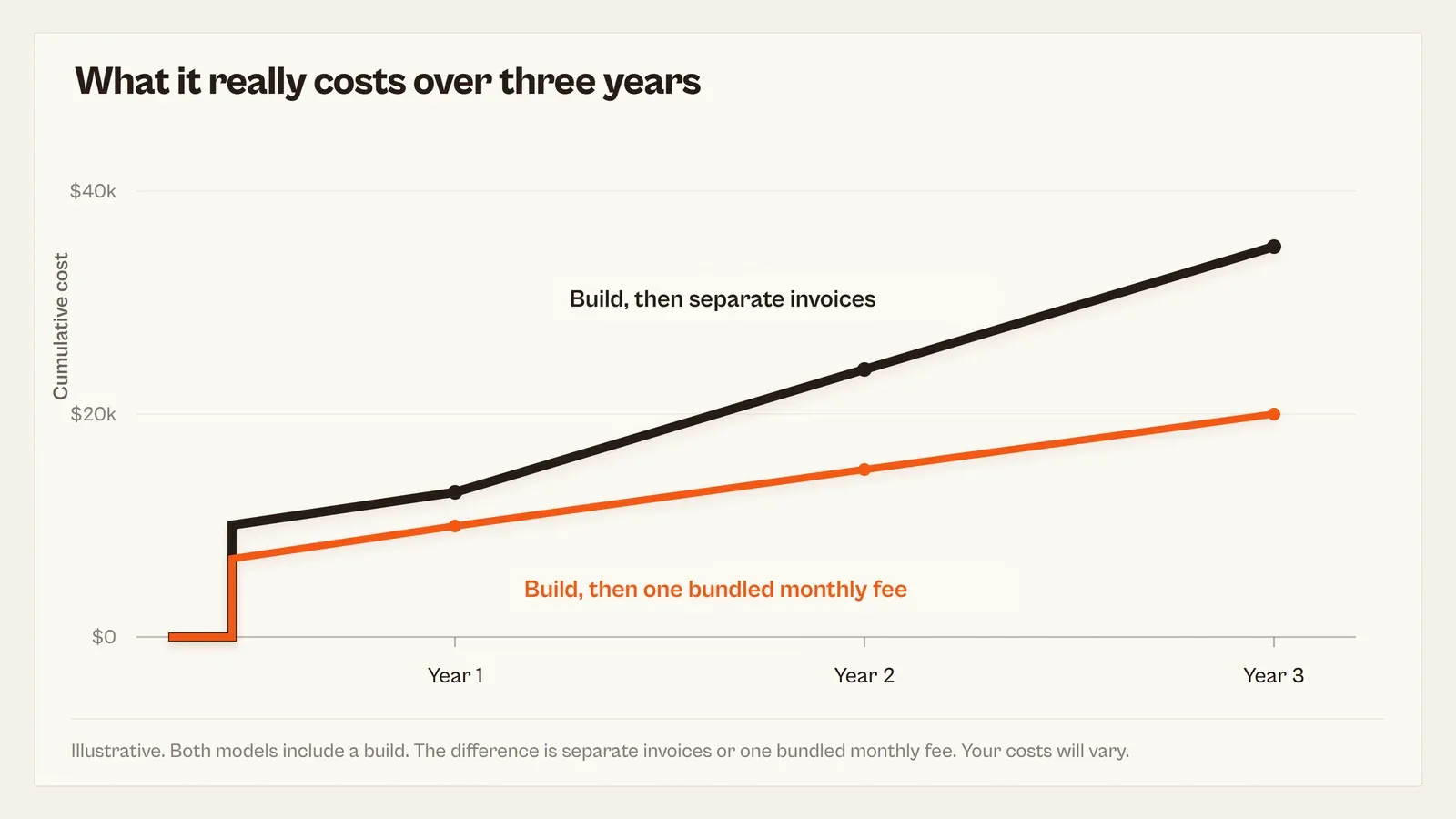
Illustrative. Both start with a build. Assembled separately, the ongoing invoices stack up and climb; bundled into one monthly fee, the ongoing cost is steadier. Your costs will vary.
Let’s name the recurring stack plainly. Hosting runs about $10 to $100 a month (WP Creative, 2026). A domain is roughly $10 to $50 a year (a .com.au is advertised from around $9.95, often a first-year rate, per VentraIP, 2025). SSL is often bundled with hosting. Maintenance is $100 to $500 a month for a small site (Comkey, 2026). And if you want active SEO, that’s another $500 to $3,000 a month depending on scope (StudioHawk, 2025).
So a $10,000 agency build is the floor of your three-year cost, not the ceiling. Add even modest ongoing care, say $300 a month across hosting and maintenance, and you’ve spent another $10,800 over three years before a single SEO dollar. That’s not a criticism of agencies. It’s simply how the one-off model works: the build is one line, and everything else is a stack of separate invoices that never stops.
This is the case for looking at total cost over total cost. Whether you spread the cost monthly or pay a big build and then a stack of retainers, you’re paying for the same fundamental things: the site, the hosting, the security, the upkeep and the visibility. The only real questions are whether they’re bundled or itemised, and whether anyone is actually doing the ongoing work or just billing you to keep the lights on.
You get what you pay for: what the cheap end quietly costs
‘You get what you pay for’ isn’t a scare tactic, it’s a statement about what is and isn’t included. The evidence is consistent: visual design is the factor people most often name when judging a site’s credibility, cited by about 46% of users (Stanford, 2002), and they form that first impression in about 50 milliseconds (Lindgaard et al., 2006). Speed and trust aren’t extras. They’re the product.
Take speed first. Portent’s analysis of over 100 million page views found a site loading in one second converts roughly three times better than one loading in five seconds for B2B (Portent, 2022). Google’s own figure is that 53% of mobile visits are abandoned if a page takes longer than three seconds to load (Think with Google, 2017). That’s general evidence about how people behave, not a promise about your numbers. But it’s the kind of thing a cheap, unoptimised template often gets wrong.
Then there’s security and upkeep, which a set-and-forget site quietly skips. Patchstack recorded 7,966 new vulnerabilities in the WordPress ecosystem in 2024, and 96% of them were in plugins, with only seven in the core software (Patchstack, 2024 data). A site nobody is maintaining is a site quietly collecting exactly these holes. The cheap end often means no one is watching, which is fine until it very much isn’t.
Local trust matters too, and it’s a genuine Adelaide advantage. auDA’s research found four in five Australians (about 80%) are more likely to trust a business whose website ends in .au, and about half will only shop at a .au site (auDA, 2025). A credible, well-kept, properly local site sends a signal a cheap or neglected one can’t. None of this means cheap is wrong. An early-stage or budget-constrained business is often right to start lean. Just budget for the upkeep, because it’s the part that’s easy to skip and expensive to ignore.
How Ohma does it differently: a fixed build, then one bundled monthly fee
Let’s be plain: this is a different way to carry the cost, not a claim to be the cheapest or best for everyone. Ohma uses the same two-part shape as the rest of the market, a build and then an ongoing fee, but it bundles the ongoing work into one monthly figure rather than a stack of separate invoices. There are four plans: Get Found ($2,900 build, then $79 a month), Get Booked ($4,900 build, then $129 a month), Get Chosen ($9,900 build, then $249 a month) and Get in Touch, the custom lane for online stores, member areas and web apps, priced on enquiry. The build is paid half to start and half at launch once you’ve approved it, so the second half only lands once the site is live.
The difference is structural, not a price brag. Every tier above quotes you a build, then bills hosting, maintenance, SEO and edits separately, often per request. Ohma’s monthly fee rolls that ongoing work into one predictable line instead. You’re not chasing a separate host, a freelancer for edits and an SEO retainer just to keep one website working.
What the monthly fee covers scales with the plan. Every plan includes managed hosting, SSL and daily backups, a Google Business Profile set up properly, an enquiry form that emails you every lead, a monthly report, and a set number of updates each month. Get Booked adds dedicated service and location pages, a CMS so you can edit the site yourself, ongoing SEO tuned for Google and AI search and a monthly Search Console review. Get Chosen adds local pages for every suburb you serve, Google Business Profile management, custom lead capture and conversion improvements from real visitor recordings, and Get in Touch is the custom lane on top for stores, member areas, web apps and integrations. On a one-off model, several of those are separate invoices or simply never happen.
The commercial terms are written down plainly, because that’s the point. The care plan is optional and runs month to month, with no lock-in or minimum term, and you can cancel any time with 30 days’ notice. Your domain and business email are registered in your name from day one, along with your logo, brand assets, photos, written content, Google accounts, reviews and customer data. Skip the care plan and you get the full site files at launch. Cancel later and the full site files are handed over at no charge.
And the honest bit on fit. This suits a business that wants the ongoing work handled in one place, on a predictable monthly figure, with a build it doesn’t have to project-manage. It is not the cheapest option, and it is not for everyone. DIY genuinely suits hobbyists. A cheap freelancer suits a tight budget when you’ve got someone to manage the upkeep. A larger agency or premium studio suits a business that can fund a big upfront build plus a separate retainer. You can see the full breakdown on the pricing page, what the build itself covers under web design, and how the ongoing care works under hosting and maintenance. We make no promises about rankings, traffic or revenue. The only claim is that the model bundles the ongoing costs you’d otherwise pay separately.
Which tier is right for you
There’s no single right answer, only a right answer for your stage and budget. The honest decision usually comes down to two things: how much upfront cash you can commit, and who’s going to do the ongoing work. Australian guides price the build at anywhere from about $200 a year to $100,000+ (Strong Digital, 2026), so the spread is enormous, and matching it to your reality matters more than the headline number.
A quick guide. If you’re testing an idea with little money and some spare time, DIY is genuinely the sensible start. If you need something more professional on a tight budget and have someone to manage hosting and updates, a good freelancer fits. If you’ve got real revenue, real complexity and can fund both a build and a retainer, a mid-range agency earns its keep. A premium studio is for established firms with complex needs. And if you’d rather have the ongoing work handled in one place on a predictable monthly fee, a bundled plan like Ohma’s is worth a look.
The bundling question is the cleanest way to choose. Either way, you pay for a build and the ongoing work that follows. The real difference is whether you assemble hosting, maintenance, edits and SEO as separate invoices yourself, or have them rolled into one predictable monthly fee. Neither is cheaper in some absolute sense. They carry the same underlying costs differently, and the right one depends on how your business likes to pay. If you want active growth work, the local SEO and conversion optimisation pages explain what that involves.
Real examples of finished work sit on the case studies page.Whichever tier you lean toward, the smartest first move is to find out what your current site is doing, before you spend on the next one. A free website audit is the quickest way to see where you stand, in plain English, with no obligation. If you’d rather talk it through and work out which tier genuinely fits your business, there’s a no-pressure call you can book any time.
Where these numbers come from: Strong Digital’s 2026 website cost guide (DIY, agency and premium bands, 2025 to 2026); Spark Interact’s web designer cost guide (freelance and agency hourly rates, 2025); Web Team Adelaide pricing and Website Adelaide pricing (illustrative published Adelaide prices, accessed 2026); WP Creative’s maintenance cost guide and Comkey’s maintenance cost guide (ongoing maintenance ranges, 2026); StudioHawk’s SEO pricing guide (monthly SEO tiers, 2025); White Peak Digital on Wix pricing and Squarespace pricing, AIAD on Shopify cost and VentraIP’s website cost guide (platform and hosting figures, 2025 to 2026); Portent on site speed and conversion (2022); Think with Google on mobile speed (2017); Stanford’s web credibility research (2002) and Lindgaard et al., Behaviour & Information Technology (2006); Patchstack’s State of WordPress Security (2024 data); auDA’s Why .au? report (2025). All build and maintenance figures are typical Australian ranges, not fixed prices, and platform pricing shifts. Ohma plan details are the studio’s own published terms.