
You typed a question into Google last week and never clicked a thing. The answer was just sitting there at the top, stitched together by AI, and you had what you needed. Now flip it around. That’s a customer, looking for what you sell, getting their answer before they ever reach your site.
That’s the worry behind most questions we hear about AI search and what it means for a small business website, and it’s a fair one. The part the headlines skip: the data says it loudest for exactly the kind of business that panicked hardest, and it does not say what you think.
On 19 May 2026, Google used its I/O keynote to make something official that has been creeping up on every business owner for two years: Search is now an AI product first and a list of links second. Google says AI Overviews have passed 2.5 billion users a month and its conversational AI Mode has crossed 1 billion, it put a new default model (Gemini 3.5 Flash) behind it, and it redesigned the search box for the first time in about 25 years. Sundar Pichai’s framing was that Search, AI agents and tools are becoming ‘one product’.
So the front door moved. Does your website still matter? It does, and for a local business the house behind that door matters more now, not less. A few specific updates will earn their keep this year in a way they would not have a year ago. What follows is the honest version, data and all, minus the panic and the hype.
The short version: Search is becoming answer-first. Your website now has two jobs: be a source the AI is happy to quote, and be the place people land when they are ready to act. The good news, straight from Google, is that there is no secret ‘AI optimisation’. Clear pages, real proof, fast load times and accurate business details do the work.
What Google actually showed at I/O 2026
Google’s message was that Search is becoming agentic and multimodal. The announcements that matter for a normal business:
- AI answers are now the default surface. AI Overviews (the AI summary at the top of results) reportedly reach 2.5 billion people a month, and follow-up questions now flow into AI Mode, Google’s chat-style search, without losing context.
- A redesigned, multimodal search box. You can search with text, images, files, even browser tabs, and Google suggests AI-driven next steps.
- Search that acts, not just answers. Google previewed ‘information agents’ that run in the background to track things for you, plus expanding agentic booking and shopping. The fuller version rolls out to paid subscribers first from mid-2026.
Two honest caveats. First, those huge user numbers are Google’s own figures, not independent measurements, so treat them as direction rather than gospel. Second, Google was explicit that ordinary blue-link results are not going away; they sit alongside the AI answers. The mix just shifts.
What the data actually says
This is where it pays to separate the scary headline from the measured reality.
The click loss is real. Seer Interactive, in the largest public study so far (5.47 million queries), found organic click-through rate fell about 61% on searches where an AI Overview appears. Pew Research, using a clickstream panel, measured clicks roughly halving on affected searches and found only about 1% of people click the links inside an AI Overview. Most searches now end without a click at all: clickstream data from Similarweb and SparkToro puts zero-click searches near 68%.
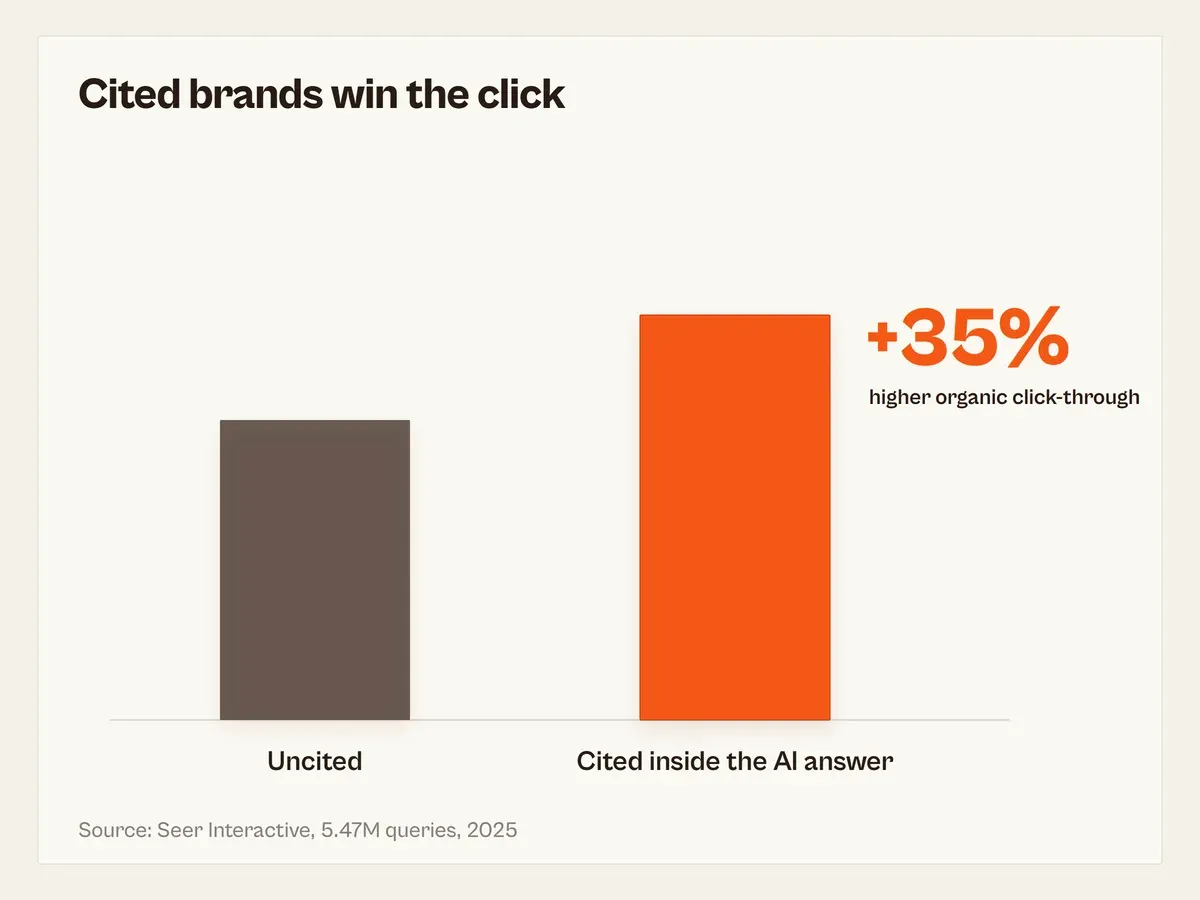
Brands cited inside an AI answer earned about 35% higher click-through than uncited ones on the same search. Source: Seer Interactive, 2025.
But two findings cut hard against the doom framing:
- Being named in the AI answer pays. That same Seer research found brands cited inside an AI Overview earned around 35% higher organic click-through than uncited competitors on the same search. The new game is less ‘rank number one’ and more ‘be the source the AI quotes’.
- The damage is uneven, not universal. AI Overviews show up on roughly 36 to 39% of informational searches (‘how does X work’) but only about 5 to 16% of transactional ones (‘emergency plumber Salisbury’). The sites getting hammered are mostly informational publishers, not local service businesses.
A fair reading of the evidence: this is a real shift that hurts thin, informational content, helps sites that earn citations, and leaves high-intent local searches largely intact for now. Worth holding onto the ‘for now’ though. Transactional AI answers have grown from about 2% to 14% since early 2025, so the protection is not permanent.
Why a local business is better placed than a publisher
For an Adelaide trade, clinic or studio, the picture is genuinely more comfortable than the headlines suggest.
| The old worry | The actual situation |
|---|---|
| ‘AI answers my customers’ questions, so they never visit.’ | Your best searches are transactional, where AI answers appear least often. |
| ‘Getting cited by AI is a whole new dark art.’ | Google says standard, helpful content is what gets cited. No special markup. |
| ‘My website does not matter anymore.’ | Your site is the trust check. Most people verify an AI recommendation before they act. |
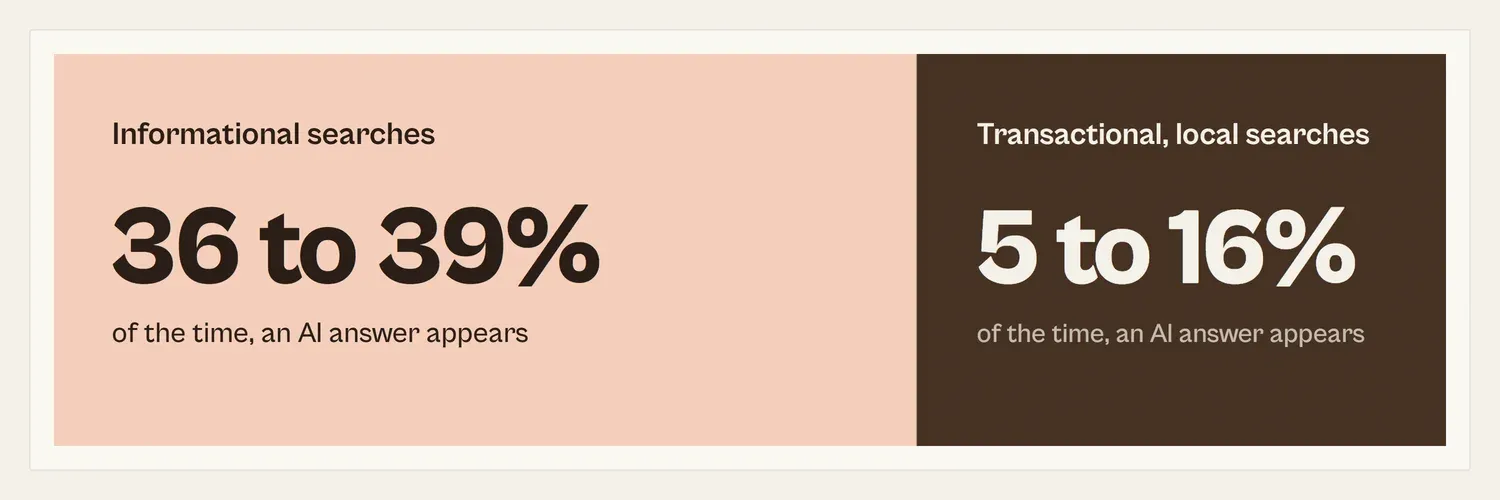
AI answers appear on roughly 36 to 39% of informational searches but only about 5 to 16% of transactional, local ones.
That last point is the one to hold onto. Trust research from Yext in 2026 found the large majority of AI citations come from data the business itself controls (its website and listings), and that most people cross-check an AI recommendation across sources before buying. AI did not remove the need for a credible website. It raised the bar for the trust signals on it.
The proof on our case studies page is built around exactly this idea: real businesses, real numbers, checkable.The thing most ‘AI SEO’ advice gets wrong
This is the part you will not hear from people selling ‘GEO’ packages. Google’s own published guidance, updated in June 2026, states plainly that there are no additional requirements or special optimisations to appear in AI Overviews or AI Mode. No AI-only schema. No llms.txt file. No magic content ‘chunking’. The advice is the same it has always been: helpful, reliable, people-first content with a clear point of view.
In other words, most of the work is the same work that has always made a good website. The December 2025 core update reinforced it: Google rewarded original research, first-hand experience and demonstrable expertise, and penalised thin aggregation and undisclosed AI filler. Answer-first writing and structured data help a machine quote you accurately, but they are table stakes, not tricks. If a ‘future-proof your site for AI’ pitch sounds complicated and proprietary, be sceptical.
What to do now
You do not need to rebuild everything. In rough order of return:
- Answer the real questions, plainly and early. For each page, lead with the one-sentence answer (‘Yes, we service the northern suburbs; here is what it costs’), then explain. This is what gets quoted by AI and what convinces a human, in one move.
- Get your business details machine-readable and consistent. Accurate LocalBusiness structured data, matching your website, Google Business Profile and directory listings exactly. Inconsistent details are worse than none; Google will discount markup it cannot trust. Only ever mark up facts that are visible and true on the page.
- Make it fast, especially on a phone. The 2026 targets are LCP under 2.5 seconds, INP under 200 milliseconds and CLS under 0.1. INP (how quickly the page responds to a tap) is the one most sites fail. A well-built site clears these by default.
- Show genuine proof. Real reviews, real results, real photos, named people. Reviews in particular drive AI recommendations, and first-hand experience is the hardest thing for a generic competitor or an AI to fake. This is the heart of answer-engine-ready SEO.
- Own the moment someone is ready to act. Make booking, calling or enquiring obvious and frictionless, which is the whole point of conversion-focused design. AI can summarise; the actual job still happens on your turf. For local businesses, keeping your local visibility tight still sends real, ready-to-buy traffic.
One more, free, that almost nobody is using yet: Google Search Console added Generative AI performance reports in June 2026. They show how often your pages appear in AI Overviews and AI Mode (impressions, though not clicks yet). It is the first real window into your AI visibility, and it is sitting in a tool you already have.
A few things not to do. Do not stuff pages with keywords. Do not publish thin AI-written filler to ‘feed the machine’; that is exactly what the December 2025 update targets. Do not chase informational keywords an AI will simply answer itself. And do not block AI crawlers hoping to protect traffic. It removes you from AI features without helping your normal Google ranking at all.
The bottom line
AI is changing the front door to your business, not the house. The fundamentals that win work online, being clear, fast, trustworthy and easy to deal with, are exactly what both Google’s algorithm and the AI assistants are now trying to reward. As the web fills with generated sameness, a genuine, well-built site for a real local business stands out more than it used to, not less.
The trajectory from here is uncertain. Even Seer’s data shows cited-page click-through recovering through early 2026 after a late-2025 dip, so this is a moving target, not a death sentence. The businesses that will do well are the ones that treat their website as a working asset: the clearest, most trustworthy answer to what their customers are asking. Do that, and whether someone arrives through a blue link, an AI Overview or an assistant’s recommendation matters far less than it sounds.
Most of this is the same work that has always made a good website. The hard part is knowing which few changes count for your site, not a generic checklist. That’s the homework we’ve already done for the businesses we look after. If you want to know whether your own front door is doing its job, a free website audit is the quickest way to see where you stand, in plain English, and there’s a no-pressure strategy call if you’d rather talk it through.
Where these numbers come from: Google Search’s I/O 2026 updates and Google Search Central’s AI guidance (Google, 2026); Seer Interactive’s AI Overview CTR study (via Search Engine Journal, 2025); Pew Research on AI Overview clicks (via Search Engine Land, 2025); Similarweb zero-click data (2026); and Yext’s AI trust research (2026). Google’s own adoption figures are company statements, not independently verified.